Key Stage 2 · History & Seasonal · Printable PDF
KS2 Remembrance Day Resource Pack
Remembrance Day Fact File and Activity Pack
£2.00
Download straight after paying. Your receipt is emailed to you too.
- Instant PDF download
- 8 A4 pages, ready to print
- Best suited to Years 3 to 6 (ages 7 to 11). Younger KS2 children may need some support with the fact file and wordsearch.
- Answer sheet included
- Dates in this pack are for 2026
A detailed but accessible look at Remembrance Day for children aged 7 to 11. The illustrated fact file goes beyond the basics. It explains why the fighting stopped at the 11th hour of the 11th day of the 11th month, what an armistice is, why poppies grew on the old battlefields in Belgium and France, and how John McCrae's poem In Flanders Fields helped make the poppy a symbol of remembering.
It also covers who we remember, including people from across the British Empire and the nurses, doctors and workers who kept things going at home, along with the history of the Cenotaph and what happens at the National Service of Remembrance in Whitehall.
The activities build from finding information to using it. Children answer questions using the fact file, then create their own fact file from memory, checking back only when they need to. The pack finishes with a writing task where they explain Remembrance Day to a younger child, which is a good way to find out how much they've really understood. A full answer sheet is included, so you can check work quickly without needing to read through the fact file yourself first.
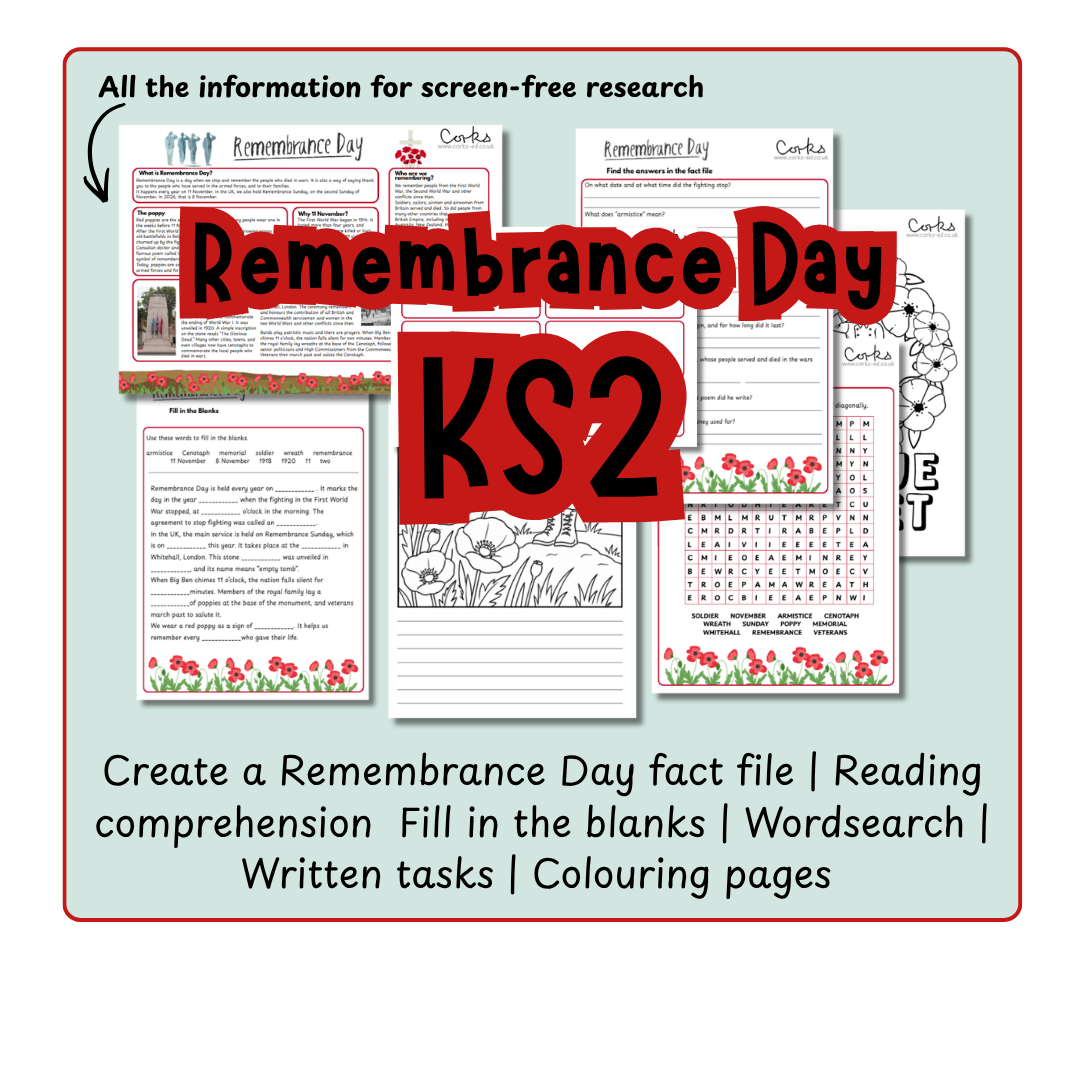
What's included (8 pages)
Illustrated fact file (A4 landscape)
Covers what Remembrance Day is, the poppy, why 11 November, who we remember, the two-minute silence and the Cenotaph, with photographs.
Create your own fact file (A4 landscape)
A blank six-box template for children to fill in from memory, checking back only when they need to.
Find the answers
Nine retrieval questions using the fact file.
Fill in the blanks
A passage with a word bank, covering key dates, the armistice and the Cenotaph.
Wordsearch
Eleven words (soldier, November, armistice, Cenotaph, wreath, Sunday, poppy, memorial, Whitehall, remembrance, veterans) running in all directions, including backwards and diagonally.
Explain it to a younger child
A writing task with a poppy field colouring scene.
“Lest We Forget” colouring page
A First World War soldier and nurse framed by a wreath of poppies.
Answer sheet
Answers for the questions, fill in the blanks and wordsearch.
How to use it
Read the fact file together or let your child read it independently, then work through the activities over a few days in the run-up to 11 November. Holding back the fact file for the “create your own” page turns it into a useful memory exercise. It pairs well with watching the Remembrance Sunday service, visiting a local war memorial, or reading In Flanders Fields together.
National Curriculum links
History (Key Stage 2)
- A study of an aspect or theme in British history that extends chronological knowledge beyond 1066.
- A local history study, when paired with a visit to a local war memorial.
- Understanding and using historical terms such as armistice, veteran, memorial and commemorate.
- Understanding how our knowledge of the past is constructed from a range of sources, including memorials and photographs.
- Selecting and organising relevant historical information (create your own fact file).
English (Years 3 to 6)
- Reading comprehension: retrieving, recording and presenting information from non-fiction, and identifying main ideas across more than one paragraph.
- Discussing and explaining the meaning of words in context (armistice, Cenotaph).
- Writing composition: using simple organisational devices such as headings in non-narrative writing (Years 3 and 4).
- Identifying the audience and purpose of writing and adapting it accordingly, through the “explain it to a younger child” task (Years 5 and 6).
Relationships Education
- Showing respect towards others, including people from different backgrounds and countries.