Key Stage 1 · History & Seasonal · Printable PDF
KS1 Remembrance Day Resource Pack
Remembrance Day Fact File and Activity Pack
£2.00
Download straight after paying. Your receipt is emailed to you too.
- Instant PDF download
- 6 A4 pages, ready to print
- Best suited to Years 1 and 2 (ages 5 to 7). Reception children can join in with adult support, and Year 3 children can use it more independently.
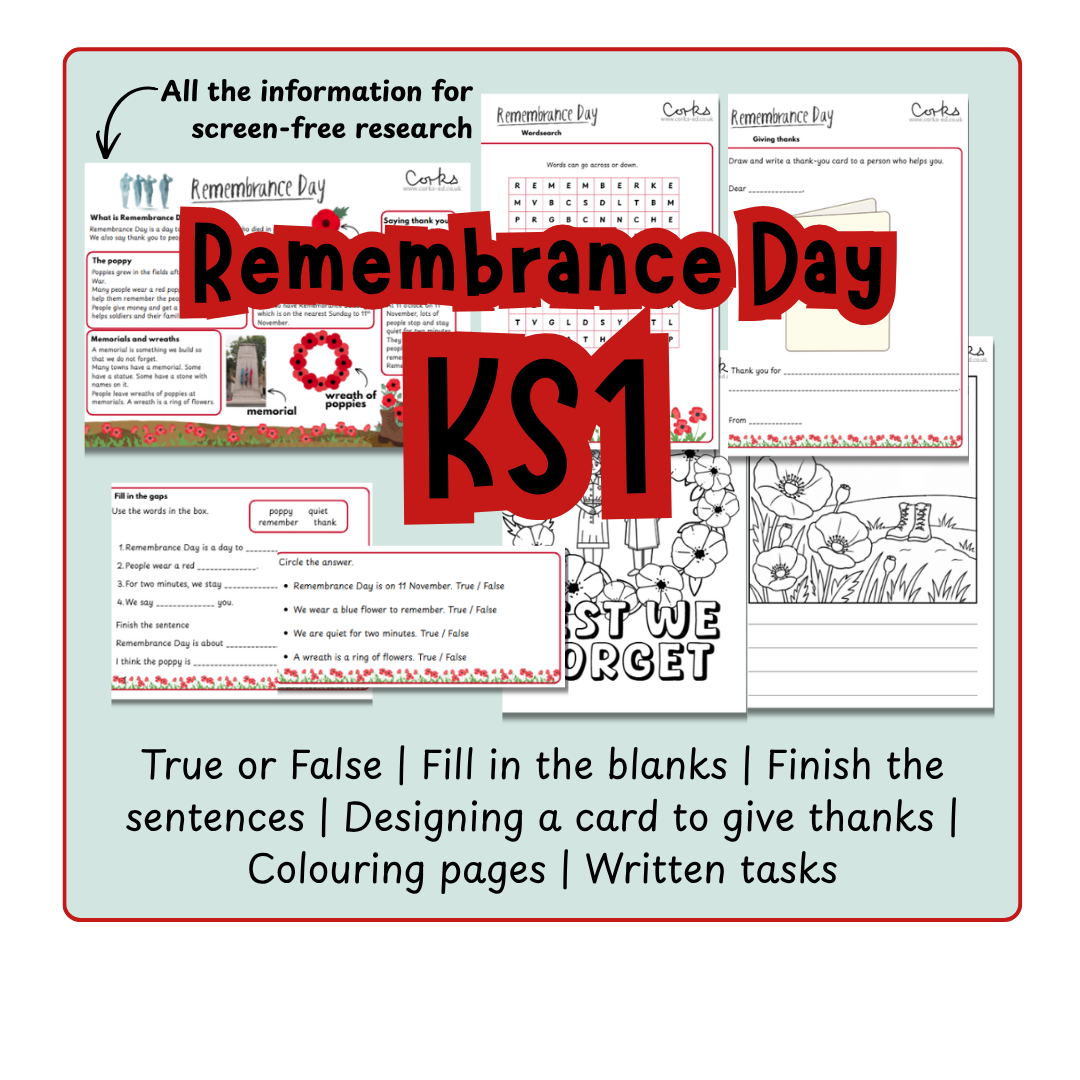
A gentle, age-appropriate introduction to Remembrance Day for children aged 5 to 7. The pack starts with an illustrated fact file that explains what Remembrance Day is, why it falls on 11 November, what the red poppy means, what memorials and wreaths are, and why people stay quiet for two minutes at 11 o'clock.
The language is simple and calm, so you can read it together without having to go into more detail about war than your child is ready for. The activities that follow send children back to the fact file to find their answers, so they're practising reading for information while they learn about the day itself.
What's included (6 pages)
Illustrated fact file (A4 landscape)
Covers what Remembrance Day is, when it is, the poppy, memorials and wreaths, and the two-minute silence, with labelled pictures of a poppy, a wreath and a memorial.
Fact file hunt
True or false questions, a fill-the-gaps activity with a word bank, and two sentence starters for children to finish in their own words.
Giving thanks
Children design and write a thank-you card to someone who helps them.
Wordsearch
Six key words (remember, memorial, wreath, poppy, quiet, thank), running across and down only.
Picture and write
A poppy field colouring scene with lines to write a sentence explaining what Remembrance Day is.
“Lest We Forget” colouring page
A First World War soldier and nurse framed by a wreath of poppies.
How to use it
Read the fact file together first, then spread the activities across a few days in the run-up to 11 November. It works well alongside a visit to your local war memorial or joining in with the two-minute silence at 11 o'clock.
National Curriculum links
History (Key Stage 1)
- Events beyond living memory that are significant nationally or globally. The curriculum gives events commemorated through anniversaries as an example, which Remembrance Day fits.
- Significant historical events, people and places in their own locality, especially when paired with a visit to a local memorial.
- Using a wide vocabulary of everyday historical terms (memorial, wreath, remember, silence).
- Understanding some of the ways we find out about the past, such as memorials.
English (Years 1 and 2)
- Reading comprehension: listening to and discussing non-fiction, discussing word meanings, and answering questions using a text.
- Writing composition: saying a sentence out loud before writing it (Year 1) and writing for different purposes, including about real events (Year 2).
Art and design (Key Stage 1)
- Using drawing to develop and share ideas (thank-you card design).
Relationships Education
- Courtesy, manners and showing respect and gratitude towards others.