Key Stage 2 · History & English · Printable PDF
In Flanders Fields Resource Pack
In Flanders Fields Poetry Pack
£2.00
Download straight after paying. Your receipt is emailed to you too.
- Instant PDF download
- 9 A4 pages, ready to print
- Answer sheet included
- Best suited to Years 4 to 6 (ages 8 to 11). Younger KS2 children will enjoy it with more adult support, particularly the translation and comprehension pages.
A complete set of activities built around In Flanders Fields, the poem written by Canadian doctor and soldier John McCrae in 1915 that helped make the poppy the symbol of Remembrance.
The pack includes the full poem in colour and in black and white, then takes children through it from several angles. They read it closely, answer comprehension questions, draw what each verse makes them see or feel, hunt for rhymes, and rewrite some of the trickier older lines in modern English. It finishes with a thoughtful writing task where children reply to the poem from the present day, over a hundred years after it was written.
A full answer sheet is included, with guidance on what to look for in the more open questions, so you don't need to be a poetry expert to support your child through it.
It works on its own as a poetry study or alongside a Remembrance Day topic, and gives children a real primary source from the First World War to explore.
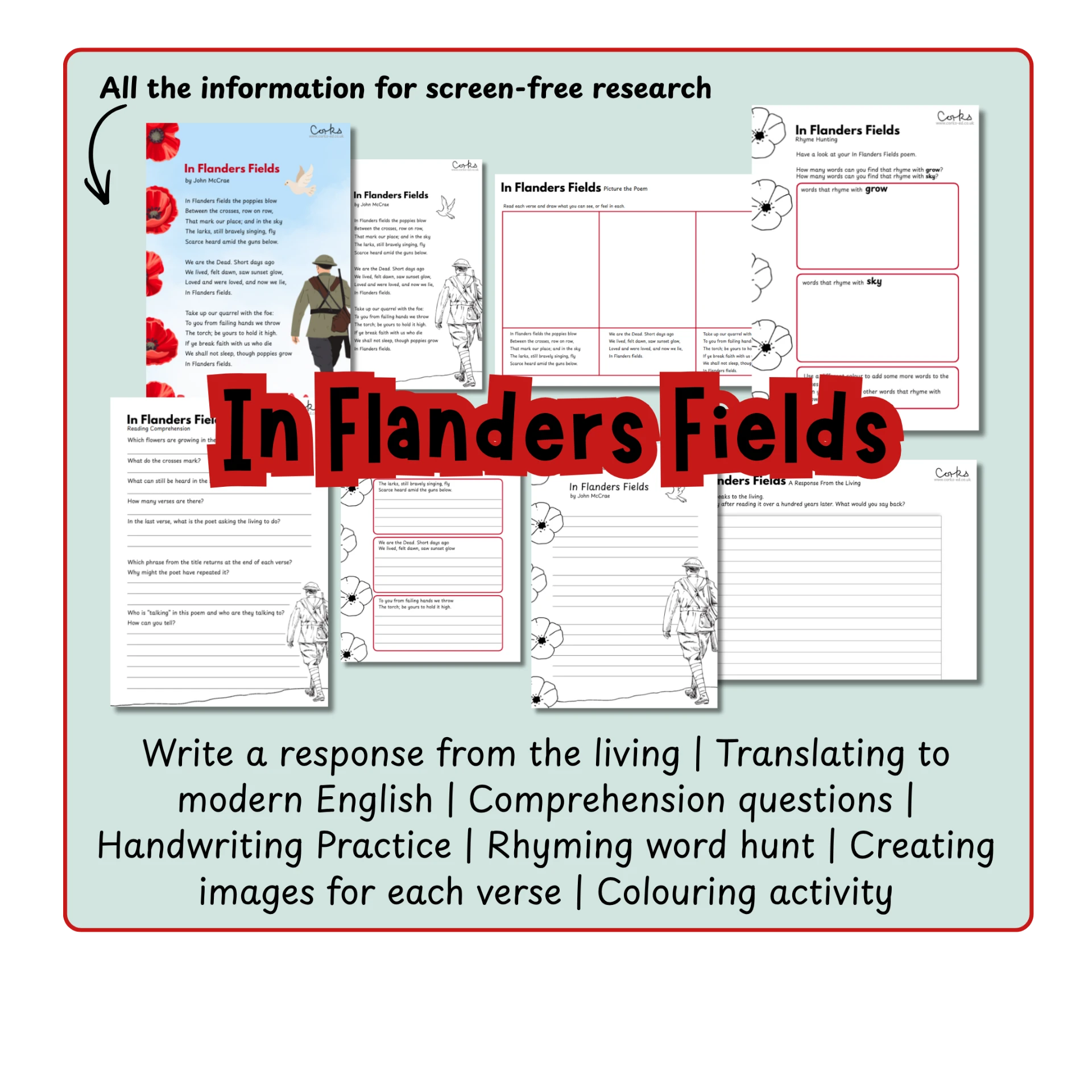
What's included (9 pages)
The poem in full colour
Illustrated with poppies and a First World War soldier.
The poem in black and white
For printing or colouring in.
Handwriting practice page
With lines for copying the poem.
Reading comprehension
Seven questions, moving from retrieval to inference (who is speaking, who they're speaking to, and why a phrase is repeated).
Picture the poem (A4 landscape)
Children draw what they see or feel for each of the three verses.
Rhyme hunting
Finding words in the poem that rhyme with “grow” and “sky”, then adding their own.
A modern day translation
Rewriting lines from each verse in modern English.
A response from the living (A4 landscape)
A writing task where children reply to the poem's message.
Answer sheet
For the reading comprehension and rhyme hunting, including suggested extra rhyming words.
How to use it
Read the poem aloud together a few times before starting, as the older language makes much more sense when it's heard. The activities can be spread across a week, with the comprehension and translation pages helping children understand the poem before they write their own response at the end.
National Curriculum links
English (Years 3 to 6)
- Reading comprehension: listening to, discussing and reading poetry, and preparing poems to read aloud.
- Increasing familiarity with a wide range of books and texts, including those from our literary heritage (Years 5 and 6).
- Discussing words and phrases that capture the reader's interest and imagination.
- Drawing inferences about characters' feelings, thoughts and motives, and justifying them with evidence from the text.
- Identifying how language, structure and presentation contribute to meaning, including repetition and rhyme.
- Discussing how authors use language, including figurative language, and considering the impact on the reader (Years 5 and 6).
- Writing composition: identifying the audience and purpose of writing, and selecting appropriate vocabulary (A Response from the Living).
- Handwriting: increasing the legibility, consistency and quality of handwriting (Years 3 and 4), and writing legibly and fluently with increasing speed (Years 5 and 6).
History (Key Stage 2)
- Understanding how our knowledge of the past is constructed from a range of sources, using a poem written during the First World War.
- A study of an aspect or theme in British history that extends chronological knowledge beyond 1066.
Art and design (Key Stage 2)
- Using drawing to record ideas and respond to a text (Picture the Poem).